Sound, Story, and Play in the Early Years
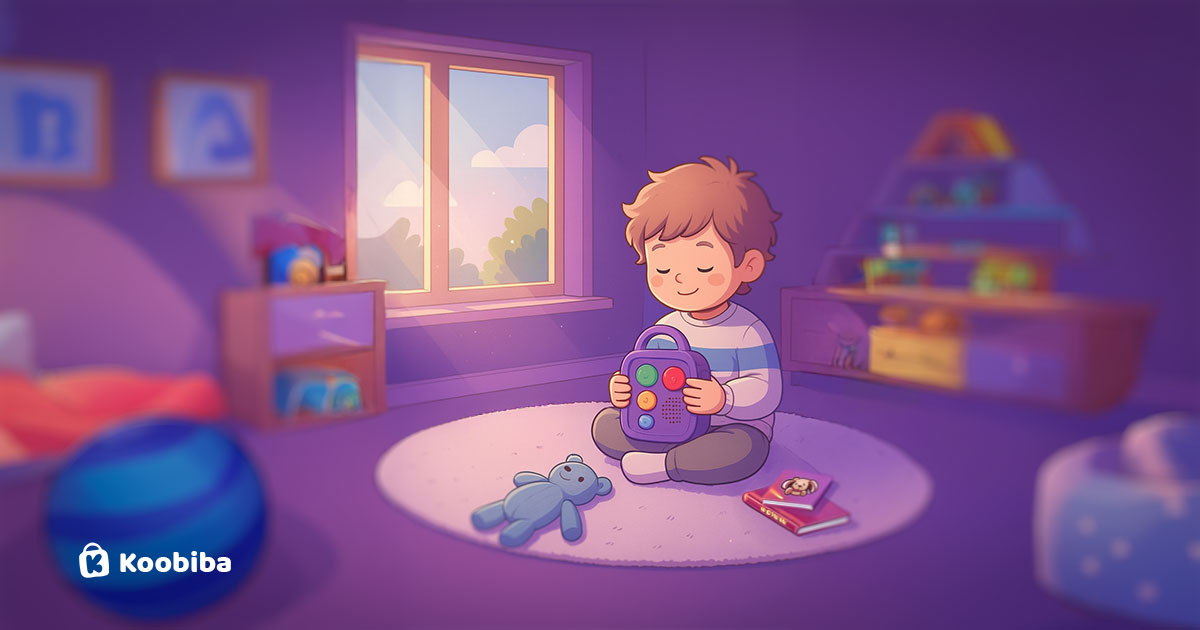
Early childhood moves at a quiet, steady pace. Children learn by listening, talking, playing, and imagining, and the simplest inputs do most of the work: conversation, stories, music, and open-ended play. In UK surveys, more than half of children (52.9%) say listening to audio makes them use their imagination more than watching video. Long before a screen is ever needed, these everyday moments are already building language, attention, and imagination.
What helps young children thrive?
The strongest ingredient in early learning is responsive, shared engagement: a caregiver narrating a moment, a child imagining along, a back-and-forth that a young brain can build on. Sound, story, conversation, and open-ended play all share this quality. They ask something of the child, attention, imagination, and participation, rather than filling in every detail for them.
1. Conversation
Children learn language through responsive exchanges. Even simple narration, such as “let’s put on your shoes… one shoe, two shoes,” strengthens connection and vocabulary. Speech develops best when it is social and two-way, not simply heard in the background. (Kuhl, 2007)
2. Storytelling and audio
Audio offers structure without overstimulation. Children picture the scene themselves, which supports focus, creativity, and comprehension. It is one reason more than half of UK children (52.9%) say audio grows their imagination more than video does (National Literacy Trust, 2025). The effect is strongest when an adult shares the story, or when a child returns to a familiar recording on their own.
3. Music and rhythm
Soft music supports emotional balance. Lullabies calm, repetition soothes, and sound helps children move between parts of the day. Rhythm and song are among the earliest ways a child takes part in language.
What these have in common is that they invite the child in. The learning that sticks in the early years tends to be active, engaging, meaningful, and socially interactive, rather than passive. (Hirsh-Pasek et al., 2015)
Where do screens fit?
Screens are part of family life, and the real question is not whether they exist but how much room the early years keep for the slower inputs. In England, two-year-olds now average around two hours a day on screens, and only about a third are within the one-hour daily guide that health bodies suggest for this age. (UCL/DfE Children of the 2020s, 2026)
The UK’s first official screen guidance for under-fives, Best Start in Life (2026), points the same way: keep recreational screen time modest for ages 2 to 5, favour slower-paced content, and watch together where you can. Global guidance from the WHO (2019) is similar, recommending no screen time before age 1 and no more than about an hour a day (less is better) for ages 2 to 4.
It is worth saying plainly that this research is associational and still emerging; the UK guidance itself describes the evidence as limited. The most consistent finding is not that screens are simply bad, but that what a child watches, and whether an adult shares it, matters more than the raw number of minutes. In one large review, adult co-use was linked to better outcomes while solo program-viewing was linked to weaker ones. (Mallawaarachchi et al., 2024)
Heavier early screen use has also been associated with more attention and communication difficulties, especially when it displaces sleep, play, or time with people (Tamana et al., 2019; JAMA Pediatrics, 2023). None of this proves cause. The simpler takeaway is that the early years benefit from keeping space for sound, story, and play alongside whatever screen time a family chooses.
Where Koobiba fits
Koobiba is a screen-free audio player for children aged 1 to 6, built to support this quieter kind of play. It delivers stories, music, and a parent’s own recorded voice, the shared, sound-based inputs children thrive on, without a screen, a microphone, or any AI. It is offline by design, so nothing a child hears depends on the internet.
That last part matters more than it used to. The UK’s 2026 guidance specifically cautions against letting young children use AI tools, toys, and chatbots. Koobiba has none of that. It simply plays what a parent has chosen, and a child picks from that library on their own.
Koobiba offers:
- stories without overstimulation
- music without distraction
- sound without visuals
- independence without digital noise
It is not a replacement for parents, and not another device competing for attention. It fits alongside reading, outdoor play, and conversation, not instead of them. That is the whole idea: not a fight against screens, but a gentle way to add more sound, story, and play to the day.
A simple takeaway
Screens will always be part of family life. But in the early years, children benefit from more room, more quiet, and more imagination. Adding sound-based moments, a story, some music, or a favourite recording, gives them that room. Koobiba exists to make that easy.
References
- WHO (2019). Guidelines on Physical Activity, Sedentary Behaviour and Sleep for Children Under 5 Years.
- Fish, J., et al. / UCL & DfE (2026). Children of the 2020s. Two-year-olds average around 129 minutes/day on screens; only 34% meet the one-hour guide.
- DfE & DHSC (2026). Best Start in Life: screen use by children aged under 5 (EYSTAG). The UK’s first official under-five screen guidance.
- JAMA Pediatrics (2023). Screen Time at Age 1 Year and Communication and Problem-Solving Developmental Delay at 2 and 4 Years.
- Mallawaarachchi, S.R., et al. (2024). Meta-analysis of early screen use and cognition; caregiver co-use associated with better outcomes. JAMA Pediatrics.
- Tamana, S.K., et al. (2019). Screen-time is associated with inattention problems in preschoolers: results from the CHILD birth cohort study. PLOS ONE.
- Picton, I. (2025). Children and young people’s listening in 2024. National Literacy Trust. 52.9% of children said listening to audio made them use their imagination more than watching videos.
- Kuhl, P. (2007). Is Speech Learning Gated by the Social Brain?
- Hirsh-Pasek, K., Zosh, J.M., et al. (2015). Putting Education in “Educational” Apps: Lessons From the Science of Learning.